Author: David Drummond

  • Tropical Storm Erin to Flood Texas

    As my friend Steve Miller wrote about in his blog, another round of flooding is in store for a large part of Texas which is only now really starting to dry out from flooding rains earlier this year, after an extreme drought the previous year! This storm will potentially bring 6 to 10+ inches of rain in a short time frame from Corpus Christi, TX north-northwestward through the Texas Hill Country and into west Central Texas.

    Tropical Storm Erin Flooding

    Flash Flood watches have already been hoisted across these areas as they are often prone to flooding when receiving large amounts of rain in a short period of time. An important observation is that most if not all of the lakes and reservoirs across the area are already at or near storage capacity. I suspect you will be seeing many stories in the news in the coming days for the effects of the flooding in Texas, and the deaths that always come with it from people that are stupid enough to drive into flooded areas.Flooding is nothing to be playing around with, especially in a car. You might have crossed that road a million times before, but you don’t know if those flood waters have washed out that small bridge, or the road bed. It takes a surprisingly low amount of water to float a vehicle!

    floodpicsignfinal.jpg

    If you live near the coast or flood prone areas, here is a nice tool to help you assess your flooding potential. FloodSmart.gov and click on the #2 link on the left WHAT’S YOUR FLOOD RISK? You can input your address and retrieve a flood map of your area.

    In addition to the flooding thread there does seem to be some tornado potential as well with the added shear from the storm system. While the potential for some tornadoes to chase would normally be something I would be interested in, the high flooding potential ruins it for me, as almost all backroads and many farm to market paved roads will be unpredictably impassible, making for an extremely frustrating chase at best. Plus, there is the potential for a hurricane chase a little down the road anyway.

    Steve also touched on the even worse impacts in the future in regards to now Hurricane Dean and it’s projected path into the Gulf of Mexico and possibly on in to Texas. Should a track in to Texas verify after Erin moves through, even if Dean comes in as a Tropical Storm (more likely a hurricane if it does come all the way in to Texas) the amounts of flooding across Texas could potentially be catastrophic! In addition to the huge amounts of rain that will come with it, already saturated grounds will insure even more widespread flooding and widespread easily uprooting of trees with their roots only having soggy ground to hold on to.

    Will this be a huge 1, 2 punch for Texas?
  • West Texas Summer Heat

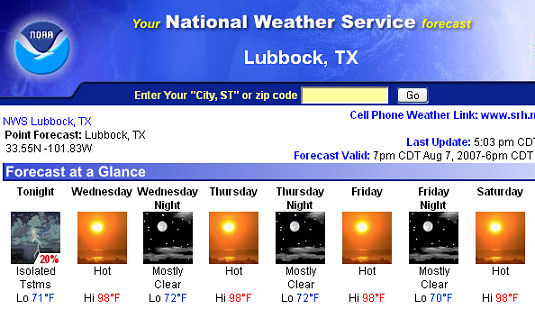
    Summer finally truly arrived this week in west Texas.

    hotsummer.jpg

    After an unusually cool summer here in west Texas, we are finally going to have some days near or above 100 degrees. For those of you reading in other parts of the country (or world) especially from up north, that might seem extreme, but it’s actually pretty common to have quite a few days in the summer hit 100 degrees or above here, most often in July and August. So far we have been seeing more temps in the mid and upper 80s rather than the mid and upper 90s.

    We have not only been on the wetter side this summer, but also on the cooler side. I for one have much enjoyed this summer, as things have been rather pleasant and unusually green across the area, and even the dry land cotton is looking outstanding. The more intense rainfall we were having earlier throughout the spring and early summer has mostly tapered off, aside from a few renegade afternoon thundershowers. Even so, dewpoints have remained unusually high for this part of the country this late in the summer. Even today as I write this, dewpoints in the mid 60s are common across the area, making it feel much more like north and east Texas than typically dry west Texas, where common dewpoints in the afternoon this time of year are often well under 40F. For those less familiar, dew point is a measure of the moisture present in the atmosphere, in this case just above ground level.

    Official high temperatures at the Lubbock International Airport averaged 5.4 degrees lower than normal in May, 3.3 degrees lower in June and 2.6 degrees lower in July. The highest official temperature so far this year at the airport has been 98 degrees, although that stands to be matched or broken this week. We have also passed our climatological peak for high temperatures, so the chances for days at or above 100F are slipping away.

    It was over a decade and half ago in 1991 that Lubbock made it through the year without officially breaking 100 degrees. Will we have another record year this year? This week will tell! If this comes to pass, it will only be the 5th time since records have been kept that this has ever happened.

    It’s interesting to note that across the area, other observation stations are reporting a similar trend of cooler and wetter than normal conditions. Looking at the nearby Childress, TX records also shows out of 31 days, only 2 days in the normal range for temps.

    All of this bodes will of course for an early and more typical fall season. I’ll go ahead and go on record and say we will see an earlier than typical first frost and freeze date this year, along with a healthy, wet winter. As the clash of the titans of Summer and Winter to once again take their Fall battlegrounds, this could potentially set up a few good severe weather episodes for the southern plains, giving us a decent 2nd season. It certainly seems the moisture isn’t in any hurry to stop hanging out in the plains.

    Of course of great interest to this writer, and I suspect most readers, is now will this play for next Spring and an active storm chase season. I am not a fan of long range forecasts whatsoever, other than just general trends and pattern recognitions, but you live out on the plains long enough, you do get a “gut feeling” for these things, that prove themselves more often than not. I know, not very scientific, but it works for me. 🙂 Of course neither I, nor anyone else knows what is in store of us next Spring.

    We came into 2007 after an extremely crappy year for chasing in 2006, that rivaled 1988. Spring 2008 will be following a more wet and cooler year on the plains, and a pretty active year for chasing. I think the southern plains will once again be active, perhaps even more later into the season than 2007 proved to be (it was great early but then shut off down south early as well). 2008 may very well see a more “normal” severe weather season for the southern part of the plains, perhaps even with Oklahoma regaining some of it’s “Tornado Capitol of the World” status back.

    Mother nature always finds a way to balance things out.