Author: David Drummond

  • 02/08/09 Storm Chase Forecast

    020809svrwxrisk

    I have been putting off talking about this for a few days now, mostly because these early year system hardly ever pan out the way they look several days out.

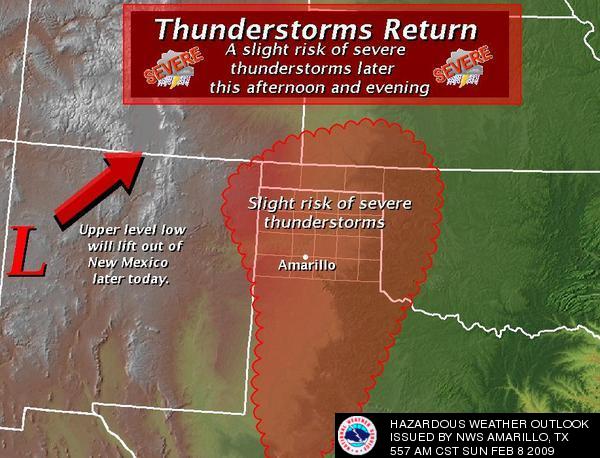
    However, it appears that we will indeed see our first severe weather of 2009 across west Texas this evening.  For the first time in months, we have some meaningful moisture back in the area, with near to just about 50F dewpoints across the area.  While meager by May standards, this is a welcome relief for months of single digit and negative dewpoints.

    Give the time of year, the lower high temps, and the overall strength of this system, this will be sufficient to get storms going late this afternoon.  So for the first time really since about last September, most of the area will received a good rain tonight, maybe 1/2 inch in some cases.

    The Storm Prediction Center has also outlooked the area with a 2% tornado risk.  Mostly due to the ample shear with this system.  Expected mode today will be in the form of a squall line, and severe weather will probably be confined to wind events, possibly some marginal severe hail events.

    If we can maintain discreet cells long enough early on, there might be a brief window of opportunity for a quick tornado.  I would expect this mostly in areas getting a little sun, such as far southeast New Mexico is now.  Storms should form in eastern New Mexico and quickly march across Texas.

    Given that, my target right now for late afternoon is Hobbs, New Mexico.  I’m not expecting much, but being the first severe weather event for the area, most likely I will be out reporting for NewChannel 11, and I am hopeful for a chance after dark to shoot some lightning photography.

    At any rate, some good rain and a chance at lightning and thunder after a long, dry winter is enough to get me out the door!

    Could be an even better potential for severe weather and chasing in north central Texas on Tuesday, but more about that later.

  • Update on FedEx Plane Crash in Lubbock, TX Weather Related?

    fedexplane1

    The NTSB has released their preliminary report of the FedEx plane crash I first told you about back on January 27th, 2008.

    What follows is the content of their report:

    NTSB Identification: CEN09MA142
    Nonscheduled 14 CFR Part 121: Air Carrier operation of Empire Airlines
    Accident occurred Tuesday, January 27, 2009 in Lubbock, TX
    Aircraft: AEROSPATIALE ALENIA ATR 42-320, registration: N902FX
    Injuries: 1 Serious, 1 Minor.

    This is preliminary information, subject to change, and may contain errors. Any errors in this report will be corrected when the final report has been completed.

    On January 27, 2009, approximately 0437 central standard time, N902FX, an Aerospatiale Alenia ATR-42-320, operating as Empire Airlines flight 8284, sustained substantial damage when it landed short of the runway threshold while executing the Instrument Landing System (ILS) RWY 17R approach at Lubbock Preston Smith International Airport (LBB), Lubbock, Texas. The airplane was registered to Federal Express Corporation, Memphis, Tennessee, and operated by Empire Airlines, Hayden, Idaho. The airline transport pilot rated captain was seriously injured and the commercial rated first officer sustained minor injuries. An instrument flight rules flight plan was filed for the flight that departed Fort Worth Alliance Airport (AFW), Fort Worth, Texas, approximately 0319. Night instrument meteorological conditions prevailed for the supplemental cargo flight operated under 14 Code of Federal Regulations Part 121.

    A preliminary review of air traffic control communications revealed that the captain contacted the Lubbock Air Traffic Control Tower (ATCT) at 0422, and reported that they were descending from an altitude of 10,000 feet down to 8,000 feet mean sea level (msl). A controller acknowledged the transmission and then provided the airport’s current weather information and a runway breaking-action advisory. In addition, he provided vectors for the ILS 17R approach.

    At 0430, the controller instructed the airplane to descend and maintain an altitude of 5,000 feet msl. At 0432, the controller informed the flight crew that the wind had shifted 180 degrees from the north to the south between 5,000 and 6,000 feet msl. The captain responded and added that he also noted a drop in the outside air temperature of 8 degrees and concurred with the controller’s observation regarding the wind shift. The controller cleared the airplane for the ILS approach at 0433 and instructed the flight crew to contact Lubbock Control Tower. The captain acknowledged.

    At 0434, the captain contacted the control tower and a controller cleared the airplane to land on runway 17R. The captain acknowledged the landing clearance and there were no further communications. Approximately three minutes later an airport maintenance employee contacted the tower and asked “what is that fire there at the end of the runway?” A controller responded, “it’s an airplane.” The controller had witnessed the accident and had activated the alarm for the airport rescue and fire fighting equipment to respond.

    An on-scene examination of the wreckage revealed that the airplane landed short of the runway threshold and collided with the approach lighting system before it skidded off the right side of the runway into the grass. The airplane came to rest on a westerly heading perpendicular to the runway. A post-impact fire consumed a large portion of the fuselage and the right wing.

    At 0415, the special weather report at LBB included wind from 350 degrees at 10 knots, visibility 2 miles, light freezing drizzle, mist, ceiling 500 feet overcast, temperature 46 degrees Fahrenheit, dew point 48 degrees Fahrenheit, and a barometric pressure setting of 30.02 inches of Mercury.